Orchid not blooming
An orchid that will not flower is usually in good health, which is what makes the question hard: nothing on the plant looks wrong. Flowering is a signal rather than a reward, so the useful question is not what the plant is short of but what it has not been told.
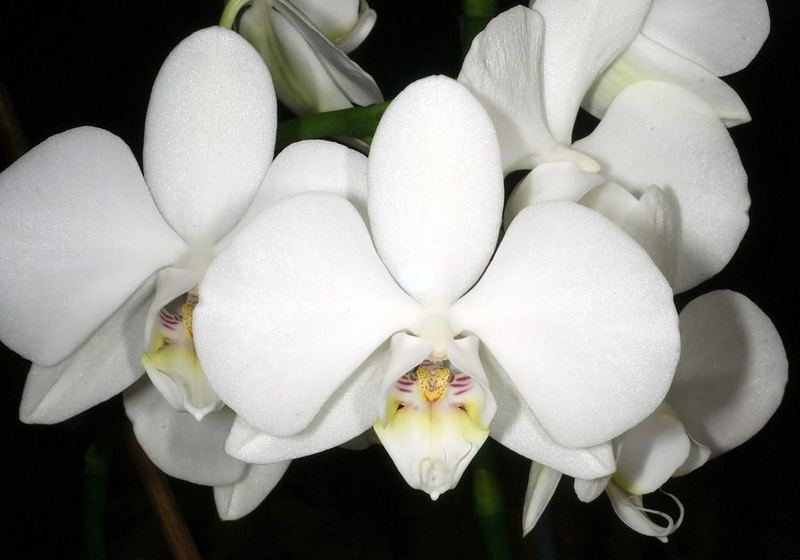
What is specific to this plant
- Orchid roots are meant to be exposed to air. Most trouble starts when the bark breaks down into something like compost and stops draining.
- Root colour is the watering gauge: green means wet, silver means ready for water. A root that is always green has never dried.
- A clear pot is not decoration. Being able to see the roots is the single most useful diagnostic tool you can give yourself with this plant.
What it could be, and how to tell
These look alike in a photograph, so each one below lists what you would ALSO see if that is the cause. Work down the list and stop at the one where the other symptoms match too.
1. No drop in night temperature to start a new spike
What else you would see
- a plant in good condition, with firm leaves and green root tips, that simply will not spike
- a position in a room held at one comfortable temperature day and night
- a last flowering that happened soon after the plant came home from a shop or a greenhouse
- new leaves arriving on schedule while nothing comes from the base of the old ones
What to do
- Give it several weeks in autumn somewhere that is cooler at night than by day, such as a windowsill in a room you do not heat in the evening.
- Keep the light the same while you do it. The night temperature is the signal, not the day length.
- Move it back once you can see a spike starting from the base of a lower leaf, and stop turning the pot from then on.
2. Light that keeps the leaves alive but will not fund a spike
What else you would see
- leaves a deep, soft, uniform green rather than a mid green with a yellowish cast
- healthy new leaves arriving, but no spike for a year or more
- the plant well back from the window, or behind a net curtain all day
What to do
- Move it to bright indirect light and leave it there. Flowering follows a whole season of better light, not a week of it.
- Judge the move by next season's growth rather than by whether buds appear within a few weeks.
- Do not compensate with feed. A plant short of light cannot use it, and the surplus builds up as salts in the mix.
3. Too little live root to carry a spike
What else you would see
- few firm roots in the pot, and most of what is there brown, flat or hollow
- bark that has collapsed into something dark and fine that no longer drains
- leaves that are limp or leathery rather than firm, even after watering
- aerial roots doing most of the work while the pot holds little that is alive
What to do
- Repot into fresh coarse orchid bark as soon as the old bark has broken down, cutting away anything soft or hollow with a blade sterilised first.
- Water on the root colour rather than on a day of the week, and this is the signal to wait for: the roots to turn from green to silver.
- Expect a full season of root and leaf growth before a spike. Feeding it harder does not shorten that.
4. An old spike still on the plant, and what it is telling you
What else you would see
- a green spike from the last flowering still standing, with no new buds on it
- a spike that has gone brown, dry and brittle along its whole length
- a healthy plant that flowered within the last year
- a small side shoot appearing part way up the old spike
What to do
- Leave a green spike in place and let it branch, or cut it back to just above a node lower down if you would rather the plant started again.
- Cut a fully brown, brittle spike back to the base with a sterilised blade, since nothing more comes from it.
- Judge the plant by new leaves and new roots while you wait. Those are what the next spike is built out of.
5. Fed for foliage rather than for flowers
What else you would see
- large, thick, healthy leaves and no spike
- a feeding routine that has not changed at any point in the year
- a white crust on the pot rim or on the surface of the bark
What to do
- Change to a feed formulated for flowering rather than for foliage, and follow the strength on the label of whatever you buy.
- Stop feeding as the plant moves into its resting season, and start again when new growth does.
- Flush the pot through with plain water first if there is a crust on the rim, since built-up salts damage the fine roots that a flower depends on.
Common questions
How long should I expect to wait before my orchid flowers?
Months rather than weeks, once the plant has been given the cooler nights it needs. A spike takes time to extend and then time again to open, and hurrying it with extra feed or extra water does not shorten either stage.
Does repotting make an orchid more likely to flower?
Only where the old bark has broken down and the roots are suffering for it. Repotting a plant whose roots are fine costs it a season while it re-establishes, and a plant re-establishing does not spike.
Is there a feed that will force it to flower?
No. A feed can remove a shortage that was holding the plant back, but nothing in a bottle substitutes for the light and the temperature change that actually start the process. Feeding harder to compensate builds salts in the mix and damages the roots the flowers depend on.
Before you act on any of this
This is general plant care guidance for a plant, not advice about people or animals. We never tell you whether a plant is safe to eat or touch, and we never tell you a plant is safe for a child or a pet. If a child or animal may have eaten any part of a plant, contact Poison Control (US 1-800-222-1222) or a vet immediately rather than reading further.
Treatment advice here is deliberately category level. We do not give product names, mixing ratios or application intervals. Whatever the label on the product in your hand says is the instruction that counts, and following it is your responsibility.
Where this comes from
The general horticultural facts behind this differential come from published university extension and Royal Horticultural Society guidance. What is specific to this plant, and the order the causes are ranked in, is ours, and the methodology page says where that reasoning stops being reliable.
- Low Light Impacts on Indoor PlantsUniversity of Maryland Extension
- Lighting for Indoor PlantsUniversity of Maryland Extension
- Indoor Plants: WateringClemson Cooperative Extension Home and Garden Information Center
- How to grow houseplantsRoyal Horticultural Society
Other orchid problems
- Orchid leaves turning yellow
- Orchid root rot
- Orchid leaves drooping
- Orchid dying
- Orchid leaves curling
- Orchid bugs
- Orchid overwatered
- Orchid leaves turning brown
- Orchid spider mites
- Orchid brown spots on leaves
- Orchid black spots
Not sure which one it is?
PlantRx is an iPhone app that reads the photo and gives you the same kind of ranked differential you just read, for your plant specifically, with the evidence it based each answer on. The first diagnosis is free, in full. There is no subscription and no account.